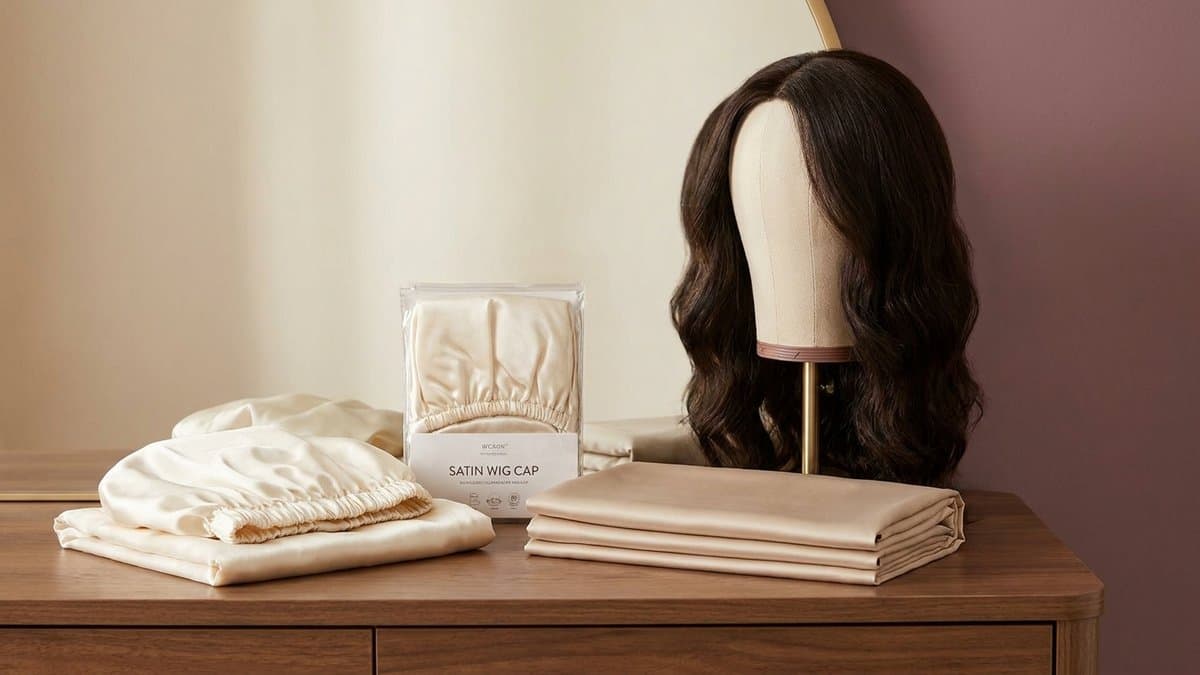
Most wig and natural-hair damage that is not from tension is from friction: the constant rub of cotton pillowcases, collars, scarves and cap linings that roughs up the cuticle, raises frizz and snaps the oldest ends. Satin and silk do one thing, and they do it well. Their smooth surface lets hair glide instead of catch, which is why they show up in nearly every care routine for wigs and for natural hair alike.
What satin and silk actually do
Hair damage accumulates where hair rubs. Cotton is absorbent and textured at a microscopic level. It grips the cuticle and wicks moisture away. A smooth satin or silk surface removes both problems: less grip means less mechanical frizz and breakage, and less absorbency means the hair and scalp keep their moisture. For a wig this means the nape and ends stay smoother longer. For natural hair underneath, it means the hairline and ends are not sanded every night.
Satin versus silk, briefly
Satin is a weave, silk is a fiber. You can buy silk satin or polyester satin. Polyester satin gives you the smooth, low-friction surface cheaply and is what most "satin" bonnets and caps are. Silk is smoother, more breathable and better at temperature regulation, but costs several times more. For friction reduction specifically, polyester satin does most of the job. Choose silk if breathability and feel matter to you or if you sleep hot.
The pieces worth buying
- A satin-lined wig cap. Worn under the wig, it protects your hair from the wig's inner seams and lets the wig glide without gripping the base.
- A loose night bonnet or scarf. Keeps the hairline and any leave-out protected at night. Keep it loose at the front so it protects without pressing, as covered in protecting your edges.
- A satin pillowcase. Protects both your wig and your natural hair on nights you skip the bonnet, and it helps any wig you store nearby.
- A satin storage bag. For folded wigs in a drawer, satin prevents the friction frizz that cotton bags and drawers cause. See how to store wigs.
How to use them in a routine
Under the wig, wear the satin-lined cap over your flattened base. At night, either keep the wig on with a loose bonnet over it, or take the wig off and store it on a stand while your natural hair gets its own satin protection. Between wears, fold the wig into the satin bag rather than tossing it in a drawer. The consistent theme is that hair should touch smooth surfaces at rest. See our protective styling guide for where this fits in the wider routine.
What satin and silk do not do
They are protective, not restorative. A satin bonnet will not add moisture, repair a dry wig or fix a tight base. Keep moisturizing the hair and scalp underneath, keep washing and conditioning the wig, and keep tension low. Satin simply stops friction from undoing that work. For the wig side of care, see caring for human hair wigs.
Frequently asked questions
- Is polyester satin good enough?
- Yes for friction reduction. It gives the smooth surface at a low price; silk adds breathability and feel but is not required.
- Do I need a bonnet and a pillowcase?
- Either works. A bonnet protects if you move a lot at night; a pillowcase covers you when the bonnet slips off.
- Does satin help a frizzy wig?
- It prevents further friction frizz at rest but does not reverse existing frizz; that needs the smoothing routine in our frizz guide.
Sources
- Wikipedia: Satin for the smooth weave that reduces friction.
- Wikipedia: Silk for the fiber's smoothness and breathability.
- r/wigs wearer experience on bonnets, lined caps and storage.