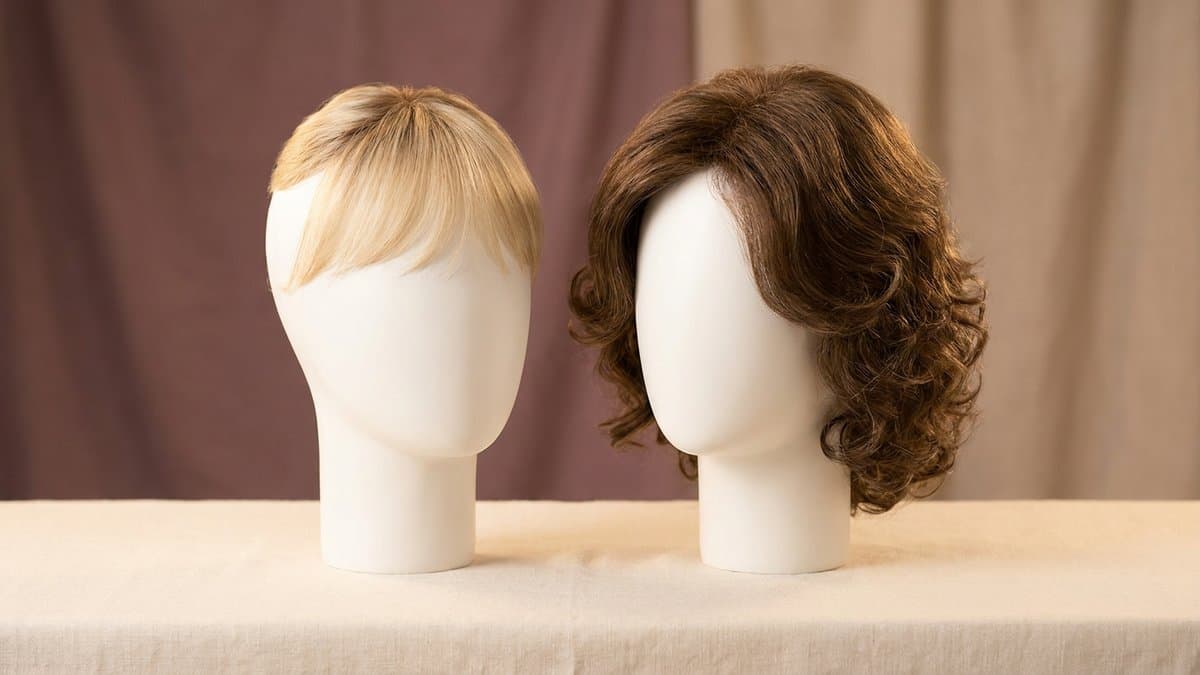
People searching for thinning-hair coverage usually find wigs first and toppers second, then wonder which one actually fits. The honest answer depends on three things: how much of your scalp is showing, how much healthy hair you have left to blend into, and how much change you want. A topper is not a smaller wig; it is a different job, and for the right head it looks far more natural than a full unit.
The short answer
If you can still wear your own hair at the sides and back and the problem is the crown, part or hairline, a topper usually wins on naturalness and comfort. If your hair is thinning all over, falling out quickly, or you want a completely different look, a full wig wins because it does not depend on blending.
When a topper is the better choice
- Localized thinning. The classic female-pattern case: a widening part and a see-through crown with good hair around it.
- You want to keep your own style. A topper adds density and coverage while you wear your length and texture.
- Lightness matters. Less cap, less weight, less heat on a scalp that is already fragile.
- Gradual change. A topper eases you in without committing to a full wig or a shaved head.
The pieces and their attachment options are in hair toppers explained.
When a wig is the better choice
- Widespread or rapid loss. If there is not enough good hair to blend, a topper has nothing to disappear into.
- A full style or color change. Wigs let you reset length, texture and color entirely.
- Medical hair loss. For chemotherapy or alopecia affecting the whole scalp, a wig is the reliable base. See medical wigs and insurance.
- You want low-morning effort. A wig goes on in one step. A topper needs your own hair washed, styled and blended around it.
Cost and upkeep
A topper costs less than a full wig of the same hair because it uses less of it, but it is not cheaper in practice if you also pay to maintain your own hair around it. Toppers need careful color matching at the roots, and bonded types need salon upkeep. A wig is a single, self-contained cost and a simpler routine. For the fiber that drives most of the price, see human hair versus synthetic.
Can you use both?
Yes, and many people do. A topper for everyday coverage and a full wig for events, travel or days you want a total change is a common pairing. Start with whichever matches your coverage today; you can add the other later. If you are leaning toward a full wig, our best wigs for thinning hair ranking and how to choose a wig for thinning hair checklist are the next steps.
Frequently asked questions
- Is a topper more natural than a wig?
- For thinning on top with healthy sides, yes, because your own hair does the blending. For full loss, a well-fitted wig looks more natural than a struggling topper.
- Do toppers show under bright light?
- A monofilament or hand-tied top with a correct color blend does not. A cheap base or a bad match is what shows.
- Which is easier to take care of?
- A wig, because it is self-contained. A topper means caring for your own hair and matching it continuously.
Sources
- Wikipedia: Hairpiece for partial versus full hair pieces.
- Wikipedia: Alopecia for hair-loss patterns and coverage needs.
- r/wigs wearer experience choosing between toppers and wigs.