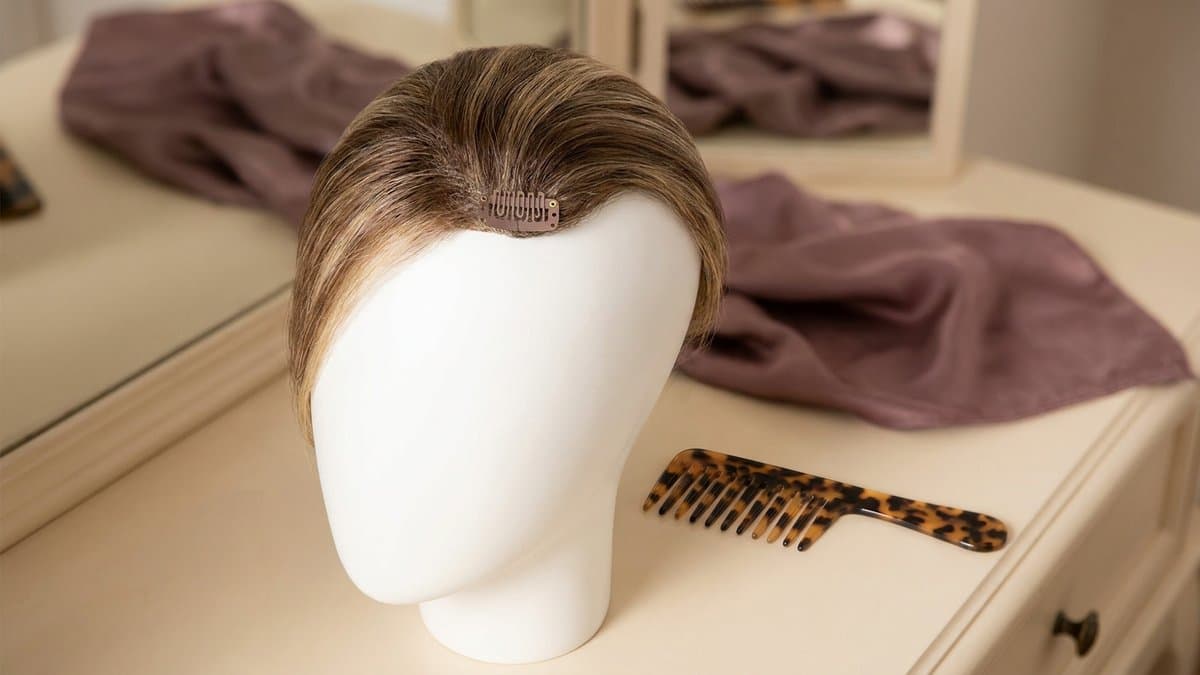
A hair topper is the piece most people do not know they can buy. It is a partial wig, a small base that covers just the crown and top of the head and blends into your own hair at the sides and back. For thinning hair that is exactly the right amount of coverage: you hide the see-through part and the widening crown while keeping your own length, texture and hairline. If a full wig feels like too much for your situation, a topper is usually the answer.
What a topper actually is
Think of a topper as a wig that only covers where you need it. The base is a small panel, often 6 by 8 inches, with your own hair left out around it. The top is built to look like scalp, so the part reads natural. The rest of your hair stays yours, which is why a topper blends so convincingly when your remaining hair is healthy.
The main types
Clip-in toppers. Small combs or clips secure the panel to your own hair; you put it on in the morning and take it out at night. They are the most forgiving and the best starting point, and they put no permanent load on fragile hair.
Tape-in and bonded toppers. Adhesive tape or bonds fix the piece for weeks at a time. They hold through sweat and wind and feel invisible, but the adhesive and removal add tension and cost, so they are a bigger commitment.
Hand-tied or integration toppers. A professional sews or bonds a semi-permanent base that integrates with your hair and lasts months. This is the most natural and the most expensive, and it needs a stylist.
Base construction. A monofilament or hand-tied top gives the realistic scalp-like part that matters most for thinning hair; a lace front topper gives a hairline when the front is also affected. See monofilament wigs for why the top matters.
Who a topper is right for
Toppers work when the thinning is on top, the part or crown, and you still have enough good hair around the sides to blend and to hold the piece. They are popular for female pattern thinning, post-partum shedding that is improving, and early alopecia. They are the wrong choice if you have little hair left to blend into or you want a full style change; that is a wig. The full comparison is in wig versus topper.
Fit and care
Match the base size to your coverage area, not larger, so the blend line stays hidden. Match the color at the roots, where the part shows, not just the lengths. Care for a topper like a human hair wig, washing and conditioning gently, and store it on a small stand. If you are choosing between a topper and a wig for thinning hair, our how to choose a wig for thinning hair checklist covers both, and the best wigs for thinning hair ranking lists sellers.
Frequently asked questions
- Do toppers damage your hair?
- Clip-ins cause little to no damage if not worn too tight. Bonded and tape-in toppers add tension and adhesive, so they carry more risk to fragile hair.
- Can you sleep in a topper?
- With clip-ins, take it out at night. Some semi-permanent bonded toppers are designed to sleep in, but follow the maker's guidance to protect the blend.
- How long does a topper last?
- Clip-in human hair toppers last six months to over a year with care. Bonded integration toppers are maintained every few weeks and replaced on a stylist's schedule.
Sources
- Wikipedia: Hairpiece for the general concept of partial hair pieces.
- Wikipedia: Alopecia for hair-loss patterns toppers address.
- r/wigs wearer experience on toppers, fit and blending.